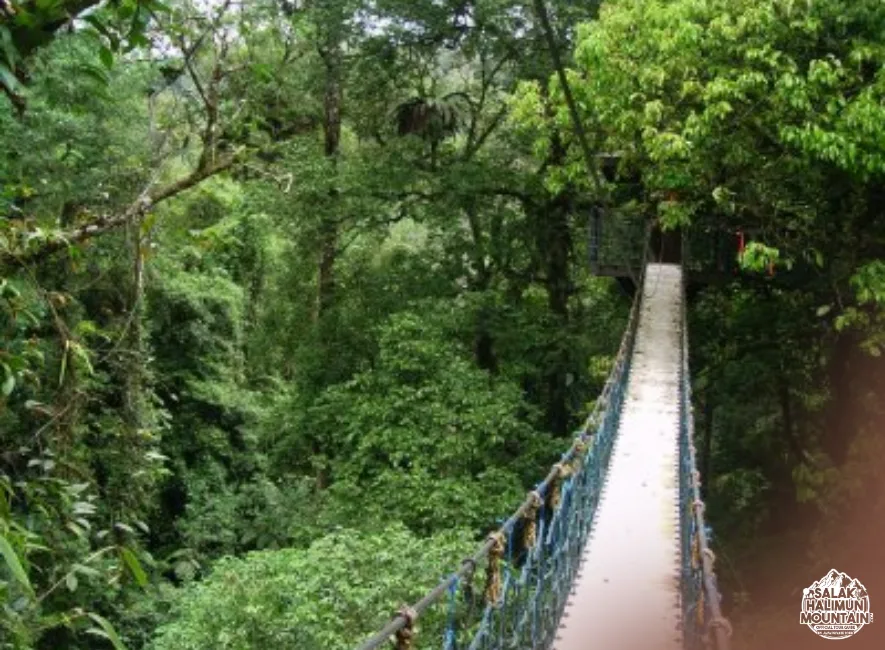
salakhalimunmountain.com – in the rainforest of Halimun Salak, life does not only exist along the trail beneath your feet. Much of it unfolds quietly above your head, in a green world shaped by sunlight, moisture, and time. Jembatan Tajuk Cikaniki offers a rare invitation to step into that world, where branches replace pathways and the forest reveals itself layer by layer.
Why the Forest Canopy Matters More Than Most People Realize
The canopy is often described as the roof of the rainforest, but this description barely captures its importance. In tropical forests like those of Halimun Salak National Park, the canopy is where the majority of biological activity takes place. It is where trees stretch outward to capture sunlight, where leaves photosynthesize and feed the forest below, and where countless species find shelter, food, and breeding space.
From the forest floor, the canopy appears distant and unified, a continuous ceiling of green. Walking across Jembatan Tajuk Cikaniki breaks this illusion. From above, the canopy reveals depth, texture, and variation. Different tree species form different shapes. Some branches are thick and ancient, others thin and flexible, swaying gently with the wind.
This upper layer regulates the forest’s temperature and moisture. It slows rainfall, allowing water to drip gradually to the ground, reducing erosion and feeding streams over time. Without a healthy canopy, the entire rainforest system below would struggle to survive.
A Living Highway for Birds
Birdlife becomes especially vivid at canopy level. Many rainforest birds rarely descend to the forest floor, choosing instead to travel and feed among the treetops. From Jembatan Tajuk Cikaniki, visitors often hear birds before seeing them, sharp calls echoing from branch to branch.
Some species move quickly, flashing color as they cross gaps in the canopy. Others remain still, blending perfectly with leaves and bark. Fruit eating birds play a crucial role here, carrying seeds from tree to tree and helping regenerate the forest naturally.
Observing birds from above offers a clearer understanding of their behavior. You begin to see how the canopy acts as a network, connecting feeding areas, nesting sites, and shelter. This perspective transforms birds from fleeting sights into active participants in a complex ecological system.
Insects That Hold the Forest Together
If birds are the visible travelers of the canopy, insects are its foundation. Walking along Jembatan Tajuk Cikaniki, small movements catch your eye constantly. Ants form living trails along branches. Beetles hide beneath leaves. Butterflies glide between sunlit openings.
Insects pollinate flowers, decompose organic matter, and serve as food for birds, reptiles, and mammals. Many insects in the canopy never reach the ground during their entire life cycle. Their world exists entirely among leaves and bark.
At this height, you begin to notice leaf damage, bite marks, and silk threads stretched between branches. These details reveal ongoing interactions that usually remain invisible to visitors on forest trails.
Epiphytes and Plants That Live Without Soil
One of the most striking discoveries at canopy level is the abundance of plants that do not grow in soil. Epiphytes such as orchids, ferns, and mosses attach themselves to tree trunks and branches, drawing moisture from the air and rain.
From Jembatan Tajuk Cikaniki, these plants appear at eye level, revealing their delicate structures and quiet resilience. Mosses hold water like natural sponges. Ferns spread fronds outward, catching falling debris that slowly creates miniature ecosystems.
These plants add weight and complexity to the canopy, creating microhabitats for insects, frogs, and other small creatures. They also help regulate humidity, contributing to the forest’s overall stability.
Hidden Life Between the Branches
Not all canopy life is easily seen. Some animals remain hidden, active mostly at night or camouflaged so well they blend into bark and leaves. Yet signs of their presence are everywhere.
Chewed leaves suggest feeding activity. Broken twigs hint at movement. Occasionally, a rustle deep within the foliage reminds visitors that the canopy is never still, even when it appears calm.
This sense of unseen life is one of the most powerful lessons offered by canopy experiences. It teaches patience and attentiveness, encouraging visitors to look beyond obvious sights and listen for subtle cues.
How Canopy Bridges Support Research and Education
Jembatan Tajuk Cikaniki is not only a visitor experience. It also serves as a valuable platform for research and learning. By providing safe access to the canopy, researchers and educators can observe plant and animal life without damaging sensitive areas.
Students studying ecology gain firsthand understanding of forest structure. Instead of learning about vertical layers from diagrams, they experience them physically. This direct exposure makes abstract concepts tangible and memorable.
Researchers benefit from being able to monitor epiphytes, insects, and birds at close range. Long term observations from canopy bridges help track changes in biodiversity, forest health, and climate impact.
Importantly, this research access is designed to be low impact. The bridge allows humans to enter the canopy briefly without clearing vegetation or disturbing wildlife patterns.
Learning Without Heavy Scientific Language
One of the strengths of canopy experiences like Jembatan Tajuk Cikaniki is their ability to teach without overwhelming. You do not need technical terms to understand that the canopy is alive, interconnected, and essential.
Watching insects pollinate flowers or birds disperse seeds makes ecological processes intuitive. Feeling the cooler air beneath dense leaves explains climate regulation more clearly than charts ever could.
This approachable learning style makes canopy walks especially valuable for young visitors, educators, and eco conscious travelers who want meaningful understanding without academic barriers.
Building Conservation Awareness Through Experience
Conservation becomes personal when people see what is at stake. Walking above the forest creates emotional connection. Visitors often leave with a deeper respect for the rainforest and a stronger desire to protect it.
Jembatan Tajuk Cikaniki helps translate conservation from an abstract idea into lived experience. The forest is no longer distant or decorative. It becomes a living community that depends on balance and care.
This awareness supports broader conservation efforts in Halimun Salak National Park, where protecting biodiversity requires both regulation and public understanding.
A Perspective That Changes How Forests Are Seen
Viewing the rainforest from above challenges common assumptions. Forests are not empty spaces beneath trees. They are layered systems where each level supports the next.
Students gain clarity. Researchers gain access. Travelers gain appreciation. All leave with a renewed sense of how complex and fragile tropical forests truly are.
Jembatan Tajuk Cikaniki does not promise spectacle. It offers insight. In doing so, it strengthens the bond between people and the living canopy that quietly sustains the rainforest below.
So, if you’re ready to explore the wonders of Mount Salak Halimun, head over to our ONLINE BOOKING PAGE and let’s start planning your adventure. Or simply CLICK THIS LINK to chat with us on WhatsApp.
With our team, you’re not just getting a guide; you’re gaining a local friend who will ensure your trip is nothing short of extraordinary.